

Quick Answer
Manual handling refers to any workplace activity involving the lifting, lowering, pushing, pulling, carrying, or moving of a load by hand or bodily force. To practice safe manual handling, individuals must conduct a risk assessment (evaluating the Task, Individual, Load, and Environment) and employ proper techniques, such as keeping a wide stance, bending the knees instead of the back, and keeping the load close to the body’s center of gravity.
Key Facts Table
| Feature | Details |
|---|---|
| Primary Regulation | Safety, Health and Welfare at Work (General Application) Regulations 2007 (Part 4, Chapter 2) |
| Enforcing Body | Health and Safety Authority (HSA) |
| Core Framework | TILE (Task, Individual, Load, Environment) |
| Most Common Injury | Musculoskeletal Disorders (MSDs) and lower back pain |
| Key Prevention Strategy | Avoid manual handling where possible through automation or mechanical aids |
Introduction
Every single day, millions of workers across industries like logistics, healthcare, construction, and retail engage in manual handling. While it seems like a routine part of the workday, improper lifting is one of the leading causes of workplace injury. According to national health statistics, musculoskeletal disorders (MSDs) account for over one-third of all lost workdays. This comprehensive guide breaks down what manual handling is, how to assess its risks, and the exact techniques needed to keep your workplace safe and compliant with [Manual Handling HSA] rules. For comprehensive training resources, certification, and expert compliance advice, you can learn more from the Irish Manual Handling Training Centre.
Key Takeaways
Manual handling extends far beyond just lifting heavy boxes; it includes pushing, pulling, and carrying.
Adhering to the TILE framework allows organizations to systematically mitigate injury risks.
Proper lifting technique relies on leg strength, spinal alignment, and keeping the load close to the body.
Employers are legally mandated to provide ergonomic risk assessments and appropriate training.
What is Manual Handling?
Manual handling encompasses any activity requiring the use of force exerted by a person to lift, lower, push, pull, carry, move, hold, or restrain any animate or inanimate object.
When done incorrectly, these activities put excessive strain on the human musculoskeletal system. Over time, or during a single traumatic lift, this can lead to debilitating injuries such as ligament sprains, muscle strains, joint damage, and chronic back pain.
Manual Handling Risk Assessment: The TILE Framework
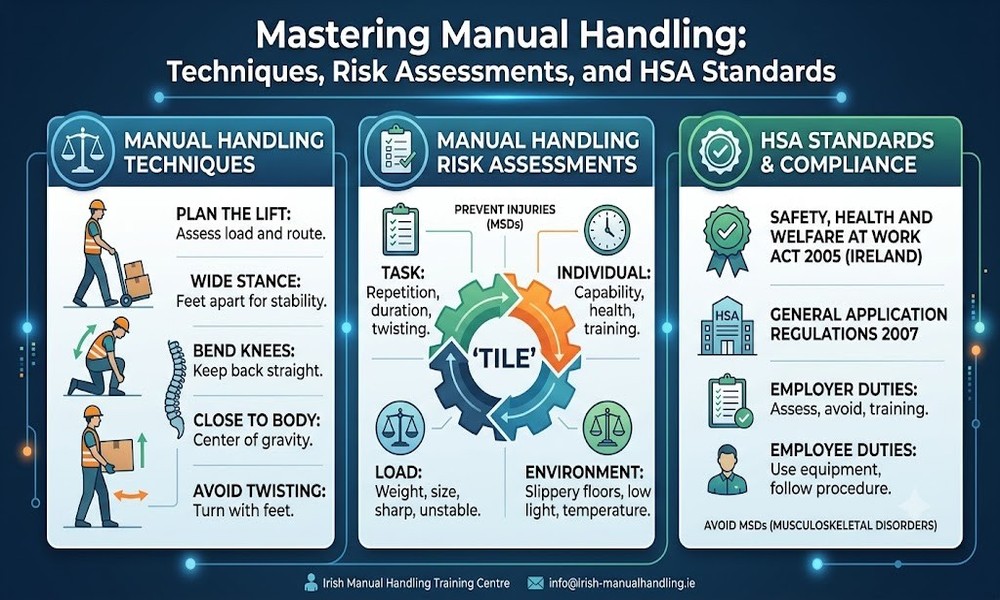
Before any worker lifts a load, an assessment must be carried out to determine if the risk of injury can be reduced. The HSA emphasizes a structured approach known as the TILE principle:
T – Task: Does the activity involve repetitive twisting, long carrying distances, or strenuous pushing
I – Individual: Does the worker have the physical capability, training, or health status required for the lift?
L – Load: Is the object heavy, bulky, sharp, hot, or unstable?
E – Environment: Are there floor hazards, uneven surfaces, poor lighting, or restrictive spaces?
Hierarchy of Risk Control
Avoidance: Can the manual handling task be eliminated completely using automation, conveyor belts, or forklifts
Assessment: If it cannot be avoided, a thorough risk assessment must be documented.
Mitigation: Introduce mechanical aids, reduce load weights, or implement team lifting strategies.
Correct Manual Handling Techniques
Implementing the correct physical technique dramatically lowers the intra-discal pressure in the spine. Here is the step-by-step process for a safe, standard lift:
Think Before You Lift: Assess the load for stability and plan your route.
Adopt a Wide Base: Place your feet hip-width apart with one foot slightly forward to maintain balance.
Bend the Knees: Lower your body by bending your knees, not your back. Keep your spine in a natural, neutral alignment.
Get a Firm Grip: Use the palms of your hands rather than just your fingertips.
Keep the Load Close: Hold the object as close to your waist as possible while rising smoothly.
Avoid Twisting: Turn your entire body by moving your feet rather than twisting your torso.
Comparison of Training Options
Choosing the right safety course is vital for maintaining regulatory compliance and protecting staff.
| Course Type | Target Audience | Key Focus Areas | Delivery Format |
|---|---|---|---|
| Basic Manual Handling | General employees, retail staff, warehouse workers | Lifting techniques, TILE framework, anatomy of the spine | In-person / Blended |
| Patient / People Handling | Healthcare workers, nurses, care assistants | Hoist usage, slide sheets, patient dignity, risk assessment | Practical Hands-on |
| Manual Handling Instructor | Safety officers, HR managers, supervisors | Pedagogy, risk assessment design, HSA legislative frameworks | Intensive multi-day |
Frequently Asked Questions (FAQ)
1. What are the legal duties of employers regarding manual handling?
Employers must avoid the need for manual handling where possible. If unavoidable, they must carry out a risk assessment, introduce mechanical aids, and provide staff with proper training.
2. What does the TILE acronym stand for?
TILE stands for Task, Individual, Load, and Environment. It is the standard framework used to evaluate risks before lifting.
3. How often should manual handling training be refreshed?
In accordance with industry best practices and general enforcement interpretations, manual handling certificates are typically valid for three years, after which refresher training is required.
4. What is the maximum weight a person can legally lift?
There is no absolute legal weight limit specified in the regulations. Instead, tasks must be assessed based on the capabilities of the individual and the environmental conditions. However, guidelines generally suggest 25kg for men and 16kg for women under ideal conditions.
5. Can online training fully replace practical manual handling training?
While theoretical components can be learned online, a practical assessment of lifting techniques by a qualified instructor is highly recommended to ensure compliance and correct physical form.
6. What is the most common injury caused by poor manual handling?
Musculoskeletal disorders (MSDs), particularly lower back pain, slipped discs, and soft-tissue strains, are the most common injuries.
7. How do you safely push or pull a heavy load?
Always choose pushing over pulling when possible, as pushing utilizes your body weight and protects your back. Keep your feet moving, avoid sudden jerks, and ensure your line of sight is clear.
8. What should I do if a load feels too heavy?
Do not attempt to lift it alone. Stop immediately and seek assistance from a colleague (team lift) or use mechanical lifting aids like a pallet truck or trolley.
Conclusion and Recommendations
Prioritizing manual handling safety is both a legal obligation and an operational necessity. By implementing systematic risk assessments, enforcing correct lifting mechanics, and utilizing professional training services, businesses can substantially lower absenteeism and foster a proactive culture of workplace safety.
