
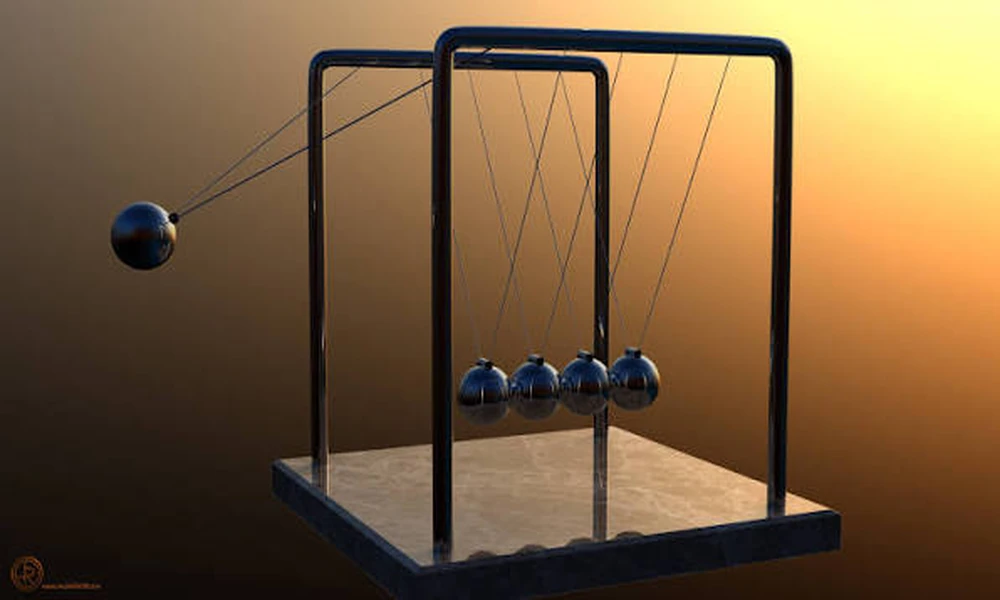

The Active Kinetic 1 Newton’s Cradle simulator is an interactive physics tool that helps students visualise the core laws of conservation. By testing binary drop patterns from simple 1 In / 1 Out swings up to 4 In / 4 Out combinations, learners build an intuitive feel for how momentum and kinetic energy move through a system. Users can toggle between live momentum and kinetic energy readouts, or view both side by side to connect physical motion directly to the underlying maths equations.
It’s ideal for exploring elastic collisions and Collision Dynamics. Newton’s cradle is one of the most recognisable physics teaching aids, turning important scientific principles into a demonstration that students can see, hear and investigate. The familiar apparatus consists of a row of similarly sized metal balls suspended from a supporting frame. When a ball at one end is lifted and released, the impact produces a striking result: a ball at the opposite end swings outward while the central balls appear almost motionless.
This simple experiment introduces the conservation of momentum and the conservation of energy, two foundations of classical mechanics. It also illustrates how mechanical forces act during collisions. The incoming ball carries kinetic energy and momentum; during the brief impact, the balls deform slightly, forces pass through their contact points, and the outgoing ball begins to move. Because a real Newton’s cradle loses some energy to sound, heat, air resistance and friction, it provides an opportunity to compare ideal physics with everyday observations.
As an educational learning tool, the cradle encourages more than passive watching. Students can release different numbers of balls, vary the starting height, record the resulting motion and predict what will happen next. Teachers can then connect these observations to scientific vocabulary, diagrams and equations, helping learners recognise why a visible effect has a mathematical explanation.
The Newton’s cradle is particularly valuable in school science lessons, STEM activities, university demonstrations and informal learning environments. Younger students may explore cause and effect, while advanced learners can examine impulse, elastic collisions and energy losses. For example, learners can compare the height reached by the outgoing ball with the initial release height, identifying evidence of imperfect mechanical energy transfer. Its enduring educational appeal lies in this flexibility: one compact, interactive device can support numerous levels of scientific enquiry and make abstract concepts memorable.
Beyond ideal frictionless motion, the Active Kinetic 1 Newton’s cradle tool brings textbook concepts to life through real-world decay and paradox modes. The Mechanical Contact Decay setting tracks energy retention over time, showing how sound, heat, and air resistance gradually slow the pendulums down. Meanwhile, the built-in 1 In → 2 Out Paradox feature gives students a clear visual demonstration of why two balls cannot exit at half speed, proving why both momentum and kinetic energy must remain balanced in elastic collisions.
Newton’s Cradle Simulator
Compare classical mechanical sphere impacts with parallel-face Active Magnetic Cradle (AMC) dipole carriages.
|
Impacts: 0 | Energy Retained: 100.0%
Visualising Physics & Equations of a Newton’s Cradle
