
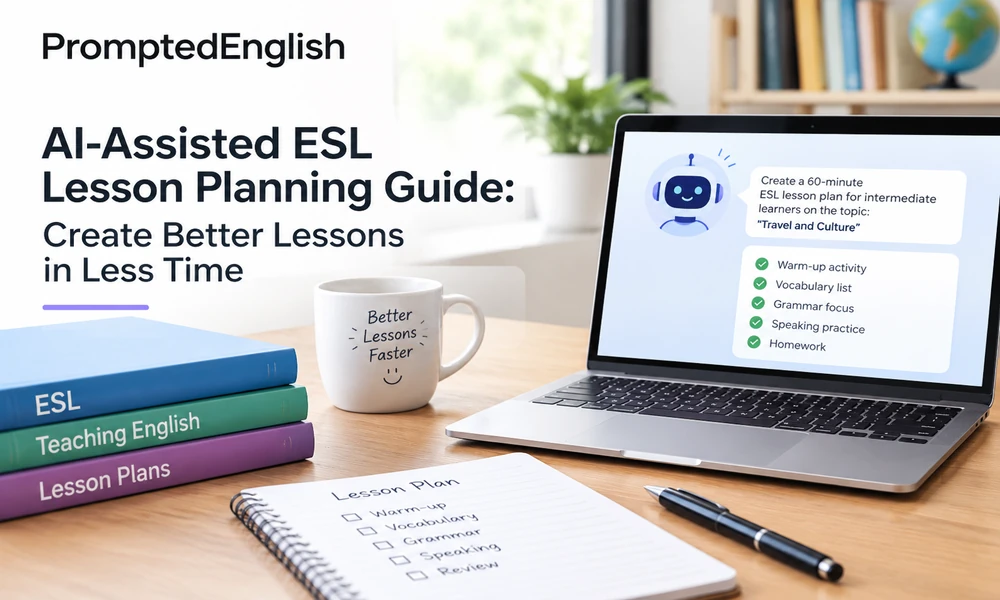

In an English Lesson, planning can take hours. It is the responsibility of teachers to select appropriate tasks, align outcomes, create resources, and accommodate diverse student capabilities. AI-assisted ESL lesson planning guide can speed up the process, while keeping the teacher in charge.
AI can be used to give inspiration, structure lessons and change activities. But the most optimal results come when AI is utilized by teachers as an assistant rather than a replacement for professional judgment.
Define AI-Assisted ESL Lesson Planning
AI-assisted ESL lesson planning type of app utilizes artificial intelligence to aid teachers in developing English lessons for students learning English as a second language.
For example, a teacher can provide the following details:
- Students’ age and English level
- Lesson topic
- Learning objectives
- Class duration
- Grammar or vocabulary targets
- Preferred teaching activities
Using those requirements, the AI will then be able to propose a simple lesson plan.
5 Ways AI Can Help You Plan ESL Lessons
Speed is one of the biggest advantages AI has. It offers teachers a template lesson structure to help start out instead of an empty page and it is done within minutes.
An AI tool can help create:
- Warm-up activities: Quick activities to ease into the lesson/have them discussing it.
- Learn vocabulary: Word list, matching exercise (quiz and build sentence activities).
- Grammar: Examples and exercises by level.
- Speaking activities: Role-plays, ready-made natural listening material, or other forms of activities.
- Assessment ideas: A quick quiz or exit-ticket question to assess understanding.
And with teachers preparing several lessons each week, an AI-assisted ESL lesson planning tool is extremely helpful.
Basic Process of Lesson Planning Using Simple AI for ESL
Outline what you want students to know by the end of your class. Make the goal specific and measurable.
Then provide the AI with precise details on your class. Some prompts are very specific, like: tell it that you have 45 minutes, are teaching a group of intermediate learners aged 14-16.
Instruct the tool to generate a lesson outline with:
- A five-minute warm-up
- Presentation of the target language
- Guided practice
- A communicative activity
- A short assessment
Then review every suggestion. Before using the material, you must check for language, examples, difficulty level of vocabulary used in it, and cultural references along with factual accuracy.
Keep the Teacher in Control
Just because something is AI-generated, does not mean that it’s right for every classroom. Others may be too hard, and some, far too easy and poorly suited for your students.
Teachers need to tailor the AI recommendations based on:
-
Student interests and needs
-
Classroom size
-
Available resources
-
Learning difficulties
-
Local culture and context
An AI-assisted ESL lesson planning guide is not designed to take the teacher out of the equation. It reduces repetitive planning work so that teachers spend less time on preparing teaching material and more time in engaging students.
Final Thoughts
When used thoughtfully, AI can make lesson planning a more streamlined experience. New activity suggestions, material adaptation, and time management assistance for teachers.
A practical step-by-step ESL lesson planning guide with the added assistance of AI gives educators to use good starting point whereby it stays within the scope of something for you to refer back while keeping human judgment front and center. Refine, customize, and enhance every AI-generated lesson before you hit that classroom.
