
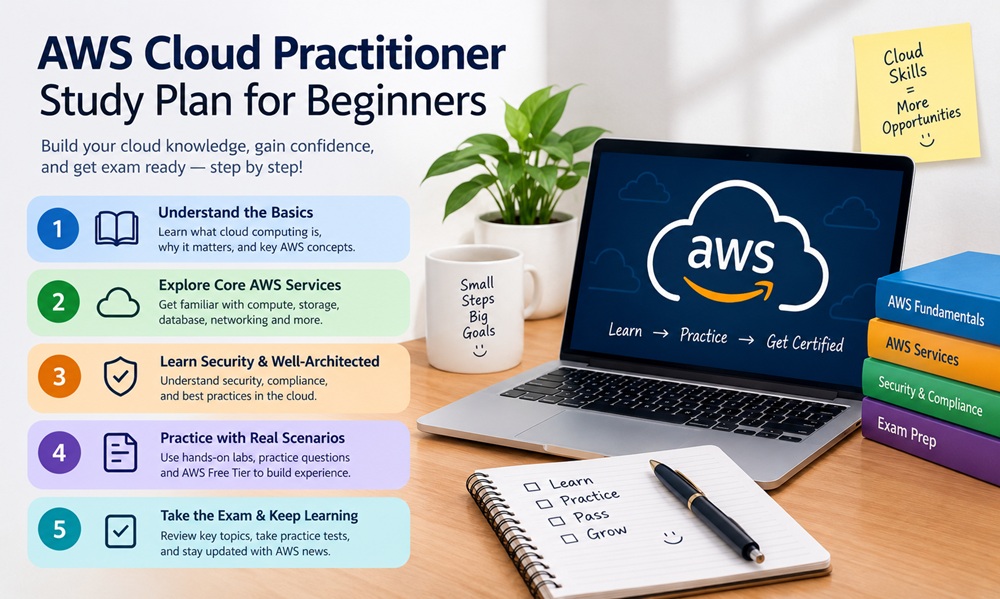

An AWS Cloud Practitioner study plan can become a long list of videos to finish. The difficulty appears later, when a practice question describes a business need and several service names look familiar. You recognize the vocabulary but cannot explain which option fits.
A better way to organize preparation is to connect each concept to a decision. What problem does the service address? What responsibility remains with the customer? Which requirement rules out an otherwise plausible answer?
This guide offers a practical sequence for beginners preparing for CLF-C02. Adjust the pace to your starting knowledge. The four-week example is a way to organize the work, not a claim that everyone needs the same amount of preparation.
Understand what the certification is designed to assess
The official AWS Cloud Practitioner exam guide describes a foundational exam covering cloud concepts, security and compliance, technology and services, and billing, pricing, and support. It does not expect candidates to perform coding or architecture-design tasks.
AWS lists 65 questions and a 90-minute examination time on its certification overview. The exam guide distinguishes 50 scored questions from 15 unscored questions and describes a scaled passing score of 700 out of 1,000. That scale should not be treated as a direct percentage-correct target for an unrelated practice quiz.
Keep the guide open while choosing a course or book. A resource should identify the exam version it supports and explain the material at the appropriate depth. An advanced engineering course may be valuable, but it is a different undertaking from preparing for this foundational exam.
Build one study system before collecting more resources
Start with three components: the official exam guide, one explanation source, and a place to record questions you cannot yet answer. Add practice questions once you have enough context to learn from the explanations.
If you want a concise reference alongside a course, Every Exam Prep’s AWS Cloud Practitioner study guide can help organize review. Use it as supplementary preparation and verify exam requirements with AWS.
Make a simple tracker with a row for each topic. Instead of marking a topic “watched,” use more informative labels: “can explain,” “can distinguish from alternatives,” and “needs another example.” These labels help you decide what to do next without requiring an elaborate study app.
Week one: explain cloud concepts in ordinary language
For the first stage, focus on the reasons an organization might use cloud services. Write explanations you could give to a colleague who has never worked in IT.
Try prompts such as:
- What would change if demand doubled unexpectedly?
- Which resources would the organization need to manage itself?
- What does paying for usage mean for planning and monitoring costs?
- Which part of a proposed solution addresses availability?
You do not need to invent a complete production architecture. The exercise is to connect a term to a practical question and notice when your explanation is too vague.
After a lesson, close the material and write a short paragraph. Reopen it only after you have identified what you cannot explain. Save the corrected version and revisit it later in the week without looking first.
Week two: study responsibility through comparisons
Security questions become easier to review when you identify who is responsible for the specific task described. Avoid the assumption that moving something to the cloud transfers every security obligation to the provider.
AWS’s shared responsibility model distinguishes its protection of the underlying cloud infrastructure from the customer’s responsibilities, which vary by service. Its examples contrast customer tasks for Amazon EC2 with those for more abstracted services such as Amazon S3.
Use a two-column page: “AWS manages” and “customer manages.” Fill it from the official explanation, then test yourself with a particular task. Can you identify the responsible party and explain why the answer changes, or stays the same, when the service changes?
Do not memorize a slogan without the examples. A useful review note names the service, the task, and the reason. That gives you something specific to check when a practice answer contradicts your first impression.
Week three: distinguish services that solve different problems
Make a comparison card whenever two names become confused. Keep each card short enough to review in a few minutes:
| Prompt | What to write |
|---|---|
| Problem addressed | The main need the service helps meet |
| Distinguishing clue | A requirement that would make this choice appropriate |
| Nearby alternative | Another service a beginner might confuse with it |
| Reason to reject it | A requirement it would not satisfy in the example |
Choose examples from the official guide and documentation rather than trying to memorize the entire AWS product catalog. The aim is a clear distinction, not an impressive list of service names.
Then work through AWS Cloud Practitioner practice questions with explanations. Before checking an answer, state the requirement that drove your choice. When you miss a question, write down the clue you overlooked rather than copying the entire explanation.
If you answer correctly by recognizing a previously seen question, mark it as familiar. That result tells you less about how you will handle a new scenario.
Week four: mix topics and inspect the reasons for mistakes
Move from single-topic sets to mixed questions. Without a topic label, you must decide what kind of problem the question describes before choosing an answer.
Track three things: the concept, your confidence before checking, and why you were wrong or uncertain. This can reveal a useful difference between “I do not know the service” and “I know the service but ignored the cost requirement.” Those problems need different review activities.
Reserve time for billing and support concepts even if they seem less interesting than technology. Use AWS’s current resources when reviewing offerings that can change; an old comparison chart should not be your final reference.
During your final practice sessions, work within a planned time block and review afterward. Keep some questions unfamiliar so you can assess whether your reasoning transfers beyond the examples you have already studied.
Can you prepare without an IT background?
AWS presents Cloud Practitioner as an entry point for people who may not have prior IT or cloud experience. That does not mean every concept will be immediately familiar. If terms such as database, network, or access permission are unclear, spend time learning them before rushing through service comparisons.
Nor does passing a foundational certification by itself demonstrate the ability to perform a cloud engineering job. If that is your longer-term goal, plan a separate next step involving practical work and the skills required by the roles you want.
For this exam, end each study session with one concrete result: a clearer explanation, a distinction between two choices, or a corrected assumption. Those small outputs make it possible to see what your preparation is accomplishing before you schedule the test.
