
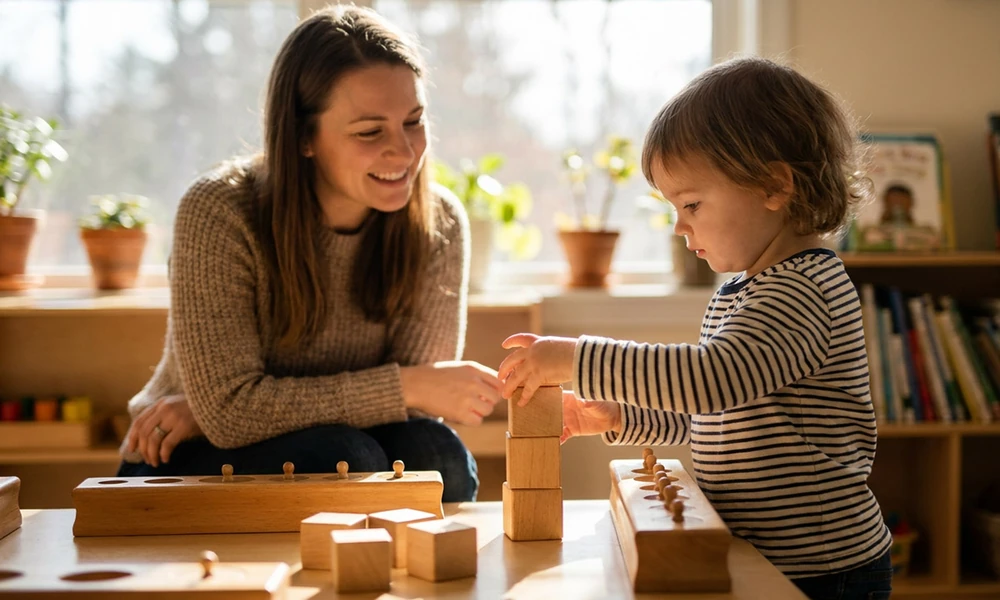

A Montessori teacher, often called a guide, is trained to watch before stepping in. Instead of teaching from the front of the room, a Montessori guide observes each child’s interests and skill level, then offers an individualized lesson at just the right moment. This “follow the child” approach shapes daily life in KV Montessori Academy’s bilingual Eastlake classrooms, where discovery, not direction, drives learning.
What Does It Mean for a Montessori Teacher to “Guide” Rather Than “Teach”?
A Montessori guide, sometimes called a directress, is a trained facilitator rather than a lecturer. She prepares the classroom, watches closely, and steps in only when a child is ready for a specific lesson, rather than running the room from the front.
According to the Association Montessori Internationale, the adult’s role is first to model calm, kind, and clear behavior for children to absorb and second to continually reflect on her habits and assumptions so she does not project them onto a child’s learning. That kind of self-awareness is part of what Montessori teacher training builds, along with a working knowledge of child development at each age.
A Montessori guide also studies the specific stage of development for the children in her room, whether that’s toddlers, preschoolers, or elementary-age students. At KV Montessori Academy, guides trained across our curriculum apply this same close observation in both English and Spanish throughout the day.
What Does “Follow the Child” Really Mean?
“Follow the child” is Montessori’s core teaching philosophy, but it is often misunderstood as unlimited freedom. Maria Montessori herself described the guide’s role as leading the child much the way a thoughtful leader follows those in her care: attentively and with purpose, never passively standing aside.
That distinction matters. A Montessori classroom does include real freedom of movement and choice, but it is freedom within limits. AMI’s own explanation of the guide’s role points to one consistent boundary that anchors every classroom: children may not harm themselves, others, or the environment. Everything else, from choosing an activity to working with a friend or alone, happens inside that structure.
A Montessori guide prepares the environment, watches closely, and steps back so the child can lead.
So “following” a child does not mean waiting passively for them to ask for help or handing them the reins entirely. It means reading a child’s readiness accurately, the way AMI’s collected reflections on the Montessori guide describe, and then leading from just behind, ready to step forward the moment it will actually help.
Why a Montessori Teacher Observes Before Offering a Lesson
Before a Montessori guide ever offers a lesson, she watches. This is not a passive habit; it is a daily practice built into how Montessori classrooms run. Guides keep ongoing notes on what each child has mastered, what still needs practice, and what seems to spark genuine interest that week.
The American Montessori Society describes this recordkeeping as a form of formative assessment that happens constantly, not just at report card time. A guide might jot down which child completed a counting activity independently or which child kept returning to the same pouring exercise for a week straight. Reviewing these daily and monthly observations tells the guide exactly which lesson to offer next and to whom.
Early childhood researchers outside the Montessori world describe a similar process. NAEYC’s guidance on using classroom observation to inform teaching emphasizes that watching children in the middle of their own play, rather than during a scripted activity, gives educators the clearest picture of what a child actually understands and is ready to learn next.
How Do Individualized Lessons Work in a Mixed-Age Classroom?
In a Montessori classroom, one guide works with children spanning two or three years of development, all in the same room at the same time. Rather than teaching one lesson to the whole group, the guide offers each lesson to a child, or a small handful of children, exactly when observation shows they are ready for it.
NAEYC’s research on planning for individuality describes how intentional teachers use daily observation to notice a specific child’s strengths, such as one who plays alone with the same materials, and then make small adjustments, like placing new materials nearby, to gently expand that child’s world. This kind of individualized planning looks different for every child in the room, even children the same age.
At KV Montessori Academy, this approach plays out across our Toddler, Primary, and Primary Advanced classrooms. A three-year-old working on pouring exercises and a five-year-old working on early math materials can share the same room because each lesson is matched to that child, not to a grade-level script. In our bilingual classrooms, that same individualized approach applies to language too, with guides offering English or Spanish lessons based on where each child is in their bilingual development.
What Is the Prepared Environment, and Why Does It Let the Guide Step Back?
The “prepared environment” is the intentionally organized classroom that makes independent learning possible. Shelves are arranged by subject and difficulty, materials are complete and in good repair, and everything has its own place, low enough for a child to reach without help.
AMI describes the deeper work behind this environment as something the guide creates carefully and then genuinely hands over to the children, resisting the urge to hover or take ownership of it herself. Much of what makes a guide effective is invisible: understanding the discipline required to prepare and release that environment so children can use it on their own terms.
Because the materials themselves are largely self-correcting, meaning a child can usually tell when a piece doesn’t fit or a pattern is off, the guide does not need to hover to catch every mistake. That built-in feedback is part of what allows a Montessori guide to observe from a small distance instead of narrating every step.
What Does a Montessori Teacher’s Minimal Intervention Look Like Day to Day?
In practice, minimal intervention looks like a guide pausing for a moment before jumping in to help, giving a child the chance to work through a small struggle first. It also looks like offering a lesson as an invitation, such as “Would you like to see something new?” rather than assigning it as a requirement.
The American Academy of Pediatrics has found that this kind of child-led, unstructured play is where much of early learning actually happens. Their research on the value of playful, child-directed learning points out that children build planning, problem-solving, and emotional regulation skills specifically through play they get to direct themselves, not through adult-led instruction alone.
Real learning often starts in the pause before a teacher decides to step in.
That waiting is a skill in itself. A guide who steps in too quickly can unintentionally interrupt the concentration a child was just beginning to build, which is part of why patience is such a core part of Montessori training.
What This Looks Like in KVMA’s Bilingual Classrooms
At KV Montessori Academy, this observe-first approach carries over into how our guides move between English and Spanish throughout the day. A guide might notice a toddler confidently naming colors in Spanish during practical life work, then offer the next vocabulary lesson in that same language before introducing the English equivalent later that week.
Because our classrooms serve families across Eastlake and greater Chula Vista, guides are watching for readiness cues in two languages at once, not just one. A child’s turn-taking during a group song, their comfort level during a Spanish-language story, or their confidence naming objects during snack time all become information a guide uses to plan the next lesson.
If you want to see the process in motion, our blog has more on how bilingual immersion fits into a typical Montessori day, and our About Us page shares more about our guides and their training.
The Takeaway
A Montessori guide’s job is not to run the classroom from the front; it’s to watch closely and offer the right lesson at the right moment. That patience is not the absence of teaching; it is what makes individualized learning possible for every child in the room.
Every child develops at their own pace, and this article is intended as general educational information rather than a promise of specific developmental outcomes or timelines.
Curious what a Montessori day actually looks like for your child? Come see it in person. KV Montessori Academy welcomes families in Eastlake and Chula Vista to tour our classrooms and meet our teachers. Schedule a Tour or call (619) 730-4020.
FAQ
Does “follow the child” mean my child can do whatever they want in the classroom? No. “Follow the child” means the guide watches closely and lets genuine interest lead a lesson, but it always happens within clear limits, such as respecting others, materials, and the classroom itself. Children still have structure, routines, and a guide actively directing their development, not unlimited free rein.
How does a Montessori guide decide when my child is ready for a new lesson? Guides rely on daily observation, tracking what a child has mastered, what they’re practicing, and what seems to capture their attention. When a child shows the skills and interest that suggest readiness, the guide offers the next lesson individually or in a small group, rather than on a fixed schedule.
What is the difference between a Montessori guide and a traditional preschool teacher? A traditional teacher often leads the whole class through the same lesson at the same time. A Montessori guide prepares an environment full of self-directed materials, observes each child individually, and offers lessons based on that child’s specific readiness, which can differ from the child sitting right next to them.
How do KV Montessori’s bilingual guides support both English and Spanish learning? Our guides observe each child’s comfort and confidence in both languages throughout the day, then offer vocabulary, stories, and lessons in whichever language matches that child’s current readiness. Over time, children are exposed to both languages consistently through daily routines, songs, and practical life activities.
Will my child still learn core Montessori skills if the teacher isn’t leading a group lesson? Yes. Individualized, one-on-one or small-group lessons are how Montessori material is actually taught. Because guides track each child’s progress closely, skills are introduced deliberately and in sequence, just on a schedule built around that child rather than the whole class.
